


Apollo: The Epic Journey to the Moon by David West
This is a beautiful book that is ultimately a beautiful tribute to all the men and women who dreamed of reaching space and the moon and then worked to make that a reality. It’s full of glossy color photos, but the text is also well written. The writer captures the spirit of wonder, adventure, and optimism of the space program and remains apolitical and nonjudgmental but still honest.The book covers man’s first dreams of going to the moon, then the Mercury and Gemini missions. Each Apollo mission is explained, then post-Apollo stuff like space stations and the space shuttle.
I learned a lot even though I thought I was pretty knowledgeable about the space program. The book contains a four-page fold-out diagram of the Saturn V, and I knew very little about the rockets before this.
You feel like you’re there with the astronauts throughout the book. Here’s the description of Apollo 8’s liftoff:
Borman, Lovell, and Anders felt the rumble originating 350 feet below them. The thrust had risen to maximum. Explosive charges fired and released all four hold-down arms within the same millisecond. The Saturn V suddenly stood on pure flame, pure force, in the air, and it rose. Fire and ice cascaded past one another as frozen condensation vibrated off the supercooled hull and rained down around the engines. The holocaust poured and blossomed. Hypersonic waves of flame bathed the flame defector’s surface, searing 1,900 F torrent blasting almost an inch of ceramic surface off the device. For 12 seconds, the Saturn V lifted, its engines moving to steer it from drifting into the launch tower.
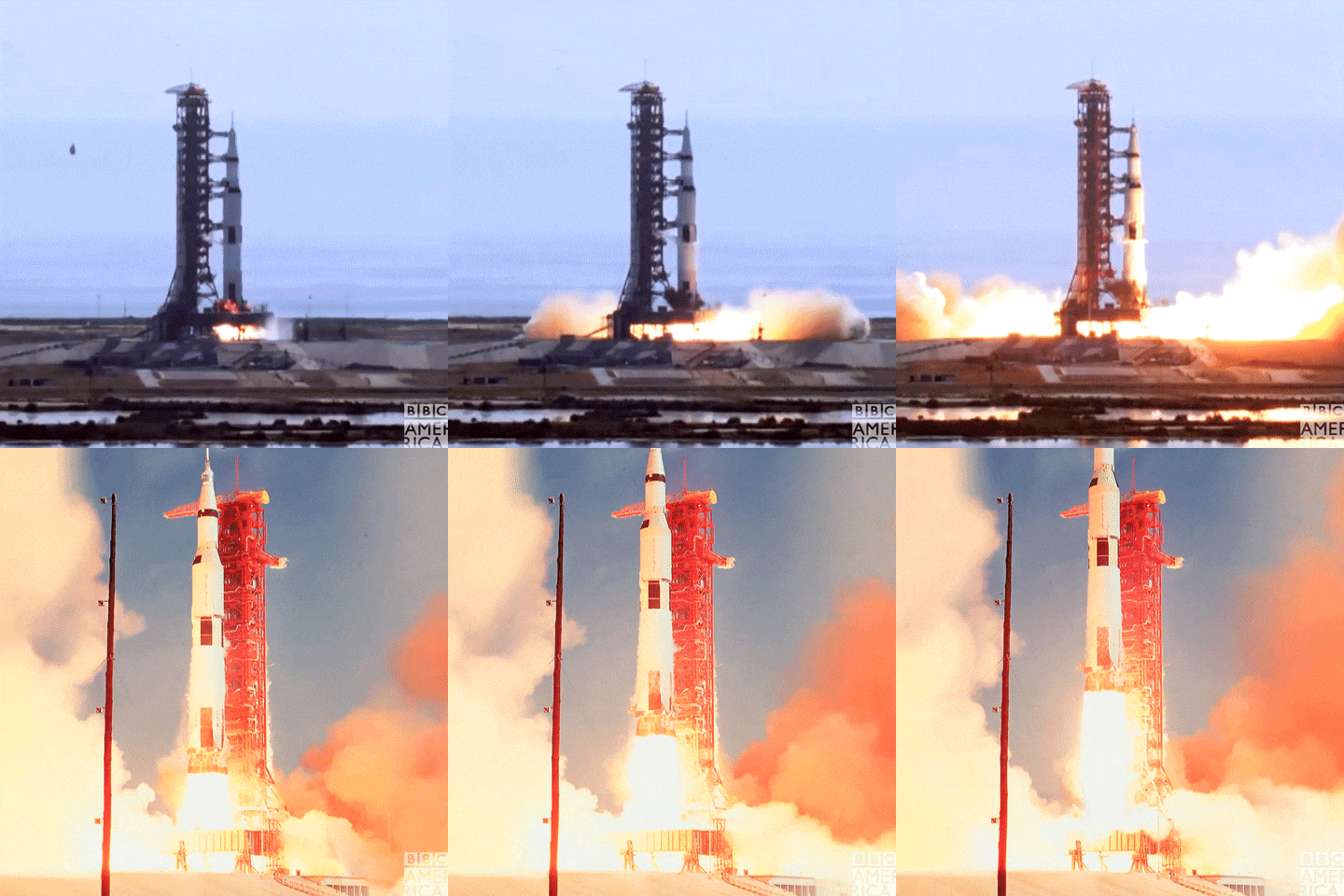

Here are a few random things I learned (mostly about the Saturn V):
● All the instructions for assembling the Saturn V were not saved, so the rocket would basically have to be reinvented if we wanted to use it again. Like, !!!
● Without an atmosphere, distances are impossible to judge on the moon. Just looking at photos shows you how.
● It took about six hours to move a rocket to the launch pad.
● Wernher Von Braun was so inspired by the movie Frau im Mond that he insisted on all the rockets being painted black and white as they were in the film.
● Bar codes were invented to keep track of all the rocket’s parts.
● Just the flames from the rocket would reach mach 3+.
I liked the map of the moon that showed all the Apollo landing sites. And it felt very appropriate to be reading it during the 50th anniversary of the moon landing. It makes a good coffee table book but is definitely worth reading every word.
* * *

Lakhoni (The Guide and the Sword #1) by Jared Garrett
This is an adventure based on ancient America. It feels like a fantasy, but there’s no actual magic in it, so that’s why I call historical fantasy.The story follow Lakhoni, lone survivor of his village’s destruction. He encounters several different groups of people as he journeys toward the capital, where he hopes to take revenge on the king. I was less interested in the journey and survival parts, but the escapes and fights were very suspenseful and exciting, as was the ending.
Some violence; clean content otherwise.
Disclaimer: I know Jared personally. But not too well.
* * *

The Last Time I Lied by Riley Sager
I was thoroughly entertained by this tantalizing mystery. There was always something fishy going on — not full of filler scenes like a lot of cozy mysteries (which this isn’t).Fifteen years ago, Emma Davis’s three cabin-mates at summer camp vanished in the night. Now Emma returns as the camp reopens for the first time since then, hoping to put to rest the memories of the three girls that have been haunting her since. How did they vanish? What were they after? And who is harassing Emma now?
There are so many possibilities; it keeps you guessing. I certainly recommend it for mystery fans.
The story is narrated in first person present tense for the later time period and past tense for the earlier period. The prologue and epilogue and a middle scene are written in second person, which is kind of weird. This is another author who doesn’t know the meaning of “disinterested” and insisted on using it wrong multiple times. An editor should have caught this.
There’s a moderate amount of strong language; some sexual content; minimal violence.
* * *

Mars by Ron Miller

This is a quick but comprehensive look at Mars, written for the junior high age group. It covers the early observations of Mars, modern exploration, and the things learned: the climate and landscape and the moons. I learned quite a lot, especially about the moons. It ends with speculation on human exploration and terraforming.
The book was published in 2006, so there have been several more probes/landers sent out since.
* * *

Gifted Hands: The Ben Carson Story by Ben Carson and Cecil Murphey
This was written in 1990, so Dr. Carson could add a whole sequel to this. Overall, this is an uplifting memoir. Dr. Carson shows how hard work and personal responsibility can get you really far. Too many people choose to be victims instead of survivors and conquerors of their destinies.I was especially impressed with mom Sonia Carson. Now that’s a strong woman — not a woman who is best at being like a man but someone who can be a mother and show kids how to be good people and excel in life. Wow.
The book covers Carson’s childhood and how he became a pediatric neurosurgeon. Then he covers a few cases that have stood out. He acknowledges the hand of God throughout his life and explains he has a Gift of the Spirit for seeing things three-dimensionally as well as amazing finger dexterity, so that’s where the title comes from. It’s an inspiring and uplifting account, something that’s nice to see once in a while.
* * *

Postcards from Mars: The First Photographer on the Red Planet by Jim Bell
This book features photos from the twin Mars rovers, Spirit and Opportunity. They launched about a month apart and landed on Mars in 2004 within a few weeks of each other. They were expected to last 90 days. Spirit lasted until 2010, and Opportunity lasted until 2015. The book was published in 2006, well before the rovers lost contact.The photos are stunning and crisp and clear. There are several four-page panoramic spreads. These are beautiful.
The text is not so interesting; I had to skim most of it. Because the author was the main photographer for the mission, the book is as much about photography (in excruciating nitty-gritty detail) as it is about Mars or exploration. There is lots of rambling; the content could have been cut in half at least without compromising any information.
The photo captions are in 6-point type. SIX. I am not exaggerating. This is not for lack of space on the page. My eyes were just not up to reading them half the time, and I didn’t feel like getting out the magnifying glass.
You can learn more about the rovers and see all the photos at https://mars.jpl.nasa.gov/mer/mission/overview/
* * *

The Last Colony (Old Man’s War #3) by John Scalzi
This third book returns to John Perry, who now lives with Jane and Zoe. They get asked to start a new colony but quickly get tired of being everybody else’s pawn in their galactic political games. There are a few twists and surprises, and John gets to do this a couple times:

The writing has lots of “he said” and “she said” tags, which I think is more noticeable on audio. There are long scenes of dialogue and steady action and plenty of snark. It’s a fun story. I got through it pretty quickly thanks to insomnia.
* * *

Mars: Distant Red Planet by David Jefferis
This is a very short book aimed at very young readers. It’s full of graphics and pictures. The information is presented in question and answer format. I think it’s to encourage kids to think scientifically. There’s not a whole lot of information, but it’s a good instruction to Mars. There are a few blatant editing errors, though.
* * *

The War that Ended Peace: The Road to 1914 by Margaret MacMillan
This is a very long book, and it’s very academic and therefore pretty dry. It reads like a dissertation, and I constantly zoned out listening to this. It goes through every country involved in WWI, gives a life sketch of every major national/military leader, and how they responded to the other countries. It’s good information—given in great detail—but hard to stay interested in.
It’s written by a British academic, so when she started taking digs at post-WWII America, my reaction was first,

and second,

All the author’s credibility as an objective historian died there.
So what led to WWI? Pride — human nature, one-up-man-ship, fear.
* * *

Skin Game (The Dresden Files #15) by Jim Butcher
This is a real solid addition to the Dresden Files. Harry gets stuck on a HEIST with VILLAINS. It’s like a paranormal Ocean’s 11.

There’s all kinds of obstacles and action and twists and treachery and all that fun stuff. There are quite a few characters, most of whom we’ve seen before. It was really nice to see Michael back in action.
And for once, our professional robbers end up with some loot.

* * *

Medusa Uploaded (The Medusa Cycle #1) by Emily Devenport
I haven’t read many generational ship books yet, though I like the idea. This book has a lot of interesting ideas, and the writing is solid and shows real talent. But I think it could have used another revision.I was confused a lot of the time. There are zero descriptions in this book. It’s as if the author was so afraid of info-dumping that she avoided exposition completely. I don’t know what the ship(s) looked like, what they were made of, how big they were, how big the hallways were, what color anything was. I still don’t get how the servants’ clothes worked. I can extrapolate a full visual image from just a little information, but I need that foundation. It’s like I was expected to explore this world blindfolded, but I failed at that.

Medusa is one of many androids that you wear. Again, without any descriptions, this was difficult to visualize. The Medusa androids can be worn like suits yet they are their own AI persons. I really don’t know how this works.
The society is broken into Executives — an aristocracy — and Worms, the servants. Oichi is a Worm. (I thought this meant she was a non-corporeal AI at first; again, no descriptions or explanations.) This society is waaaaaayy too airlock-happy. The ship appears to have about 200 airlocks. (Why so many??) They are used almost every day for executions, murders, and suicides. They are never monitored, guarded, or locked, apparently.

As a music teacher, I appreciated Oichi’s dedication to music. It WILL make kids’ brains smarter.

But I never knew what her goals were beyond sharing music with everyone else. Social equality? General knowledge? It just felt like she was meandering around, collecting other outcasts and getting tossed out of airlocks repeatedly. Also, the author doesn’t know what reticent and disinterested actually mean. A decent editor should have fixed that.


No comments:
Post a Comment