


Published in 2014, there’s tons of cybercrime that’s popped up since then. I suggest following Brian Krebs’s blog to keep up to date. Krebs started off as in investigative reporter but left to run his own blog when his articles became too hot to handle for the paper.
The book follows the history of email spam in its heyday. It’s actually been declining in favor of phishing, ransomware, and other scams.
It turns out the vast majority of spam came from Russia from only a handful of people. They viewed spam as legitimate advertising for prescription drugs, porn, and fake antivirus programs (scareware), especially drugs. Enough people buy spammed products for it to be a lucrative business.
Researchers concluded that spam—and all of its attendant ills—will remain a prevalent and pestilent problem because consumer demand for the products most frequently advertised through junk email remains constant.
Spam was seen as more of a nuisance than a threat, even though spammers infect personal computers and use them to send spam. Krebs had an incredibly difficult time getting spam-sold pills tested. Drug companies were also to crack down on spam since some of the drugs were safe enough.
Incredibly, the [University of Alabama at Birmingham] researchers have legal approval from federal regulators and law-enforcement agencies to test and handle highly controlled and illegal substances, such as cocaine, heroin, and a methamphetamine, but they had not yet received permission from the FDA and DEA to test pills ordered through junk email.
Spam rivalry seriously hurt the spam industry, and when the credit card companies got involved, they took a big hit.
So it’s an interesting history and not quite what I expected. I was most interested in who was buying from spam and why. I would have liked to hear more about the anti-spammers and their efforts. The spammers themselves were not that interesting.
Recommended for anyone interested in computers and cybercrime. Editing is pretty well done. There is some strong language in quoted material.
Brian Krebs
* * *

Even though this is outside my normal genre, this book sucked me in and refused to let go. While reading, I was living Lilli’s life and agonizing over how things would turn out for her.
It was impossible to be an independent woman back then (1883). So many people get hurt over trivial injustices they don’t see the real ones or remember how good they have it. Reading this book will make you very indignant over the injustice and double standards of the time and very grateful for the time you live in.
The depictions of caring for a newborn are spot on. Reading about cracked nipples, I thought, praise to God for lanolin, and then I read that they had lanolin and was like, Use it, Sister! And that stupid advice about forcing a baby to wait four hours between feedings is still going on today! I had a baby or two who were fine eating every three to four hours. But I had two (boys) who needed it at least every hour, and to deny them that would not only have increased both of our discomfort, it would have been a betrayal to the baby who was just learning to trust. The author also captures that sense of touching the divine you get from feeling a baby kick and when nursing to seeing your child create something of her own.
“Live up the light thou hast; and more will be granted thee.”
“I was stunned at being the basis of a newborn’s survival and awed by how my body and heart changed in service of her. Becoming a mother was no small shift in identity. I would never see any aspect of living in the same way again.”
“Do not be surprised, when thee has children, to find what I have found: of all the kinds of love that bind, a mother’s love for her offspring is the strongest imperative on earth. It is as common as sunlight, as all-penetrating, as necessary to life.”
“If our principles are right, why should we be cowards?”
It is beautifully written, hands down. It ended kind of abruptly. I would have liked to have seen what happened to all the secondary characters or a glimpse into the future.
* * *

Indie books are hit and miss, and it’s a great pleasure in finding that hidden gem among them. This book easily matches (and surpasses in some cases) traditionally published books coming out in quality.
This is a science fiction story that’s a blend of dystopia and post-apocalyptic. The three main characters—Everly, Halla, and Wyck—live an in InKubation Kube, where children have been repossessed by their parents. They are solid characters who actually act their age. (Halla makes some REALLY stupid choices near the end.)
The world is interesting, the plot is not predictable, and pacing is steady. For the most part it was edited really well, but there were parts that weren’t. I suspect revisions were made after editing that never got checked.
This book is a permanently free ebook.
* * *

Sadly, this is my first book by Charlie, one of many talented local authors. The writing is excellent—it hardly matters what the book is about because just the writing made it good.
It’s about Smitha, a vain and selfish 17-year-old, who ends up cursed to be always freezing cold. As she brings snow and cold wherever she goes, she spends a lot of time in exile. The core of the book is seeing Smitha transform as she learns to use her curse for good and to become completely selfless.
The pacing is right on, the characters and world-building are well done, and it’s easy to become swept up in the story. I mean, I felt extra cold while reading it, and I was emotionally invested in the characters.
* * *

This episode of Discworld stars a new pharaoh, just graduated from Assassin’s College. (The parts at the assassin school were my favorites.) The young pharaoh's dad has just died, but the dad gets to remain a character in the book. Death has only a very small appearance.
The dead pharaoh, now aware of what death is like, decides he doesn’t want to be buried in a pyramid; his country (D’Jelly Baby) has gone bankrupt building elaborate pyramids. But, being dead, his wishes are ignored, and a grand pyramid is under construction. However, giant pyramids have a way of attracting quantum magic of a sort, and that results in crazy stuff in the kingdom.
So the plot is kind of strange, but there are plenty of funny bits. The camels were my other favorite part.
Her singing always cheered him up. Life seemed so much brighter when she stopped.
This means either that the universe is more full of wonders than we can hope to understand or, more probably, that scientists make things up as they go along.
His ancestors had been keen on pyramids. The pharaoh wasn’t. Pyramids had bankrupted the country, drained it drier than ever the river did. The only curse they could afford to put on a tomb these days was “Bugger Off.”
He pushed the food around on his plate. Some of it pushed back.
* * *

I recommend going in blind to this book for the full experience. Don’t read any reviews or blurbs; I thought a lot of GR reviews hinted too much. I am trying not to do that.
This is a blend of contemporary and psychological suspense. The first half follows Amber, a psychopath, as she insinuates herself into the life of Daphne Parrish. Amber is filled with envy and wants Daphne’s life—she intends to replace her.
It’s interesting to see how Amber rationalizes all her actions. Life is so unfair; she deserves to be rich and lazy. You know she’s a villain, yet you worry about her getting caught. It’s fun. The second half is Daphne’s POV until the end, where it switches quickly between the two. In the middle I was hoping for a specific ending, and I got it. It was quite satisfying.
True, the characters are a bit flat—they’re either all bad or all good. It didn’t bother me as it worked fine for the story. The writing was good and smooth, making it easy to race through the pages. Pacing was just right. It was quickly very hard to put the book down!
There is some occasional moderately strong language and some sexual content as well as some depictions of abuse.
* * *

In this episode of the Dresden Files, crime boss Marcone has gone missing, and Mab calls in a favor from Harry to go rescue him. But the biggest bad is the return of the Denarians (the fiends tied to the coins paid to Judas). And the Goats Gruff get involved.

There’s a good collection of side characters: Bob, Michael (my favorite), Sanya (the other Knight), and the Archive (Ivy). There’s lots of danger, and Harry gets beat up pretty bad. He also gets a new crush.
I cracked up plenty of times, especially at these bits:
If your opponent has you by fifty pounds, winning a fight against him is a dubious proposition, at best. If your opponent has you by eight thousand and fifty pounds, you’ve left the realm of combat and enrolled yourself in Road-kill 101. Or possibly in a Tom and Jerry cartoon.
Molly was committing dinner by that time, aided and abetted by Sanya, who seemed to take some kind of grim Russian delight in watching train wrecks in progress.
“Likest thou jelly within thy doughnut?”
“Nay, but prithee, with sprinkles ’pon it instead,” I said solemnly, “and frosting of white.”
* * *

This was a solid mystery/thriller that fans of the genre should enjoy. It’s not too long, so the pace is steady.
A young boy miraculously escapes his family being murdered by an ax murderer. The killer keeps coming after him, which was exciting. He ends up staying with the detective main character as his extended family are all potential suspects as well as potential victims, neither of which is a good thing for the kid. The pool of suspects was surprisingly small.
I had a few things to nitpick. If you memorize a piano piece, you will forget it if you don’t play it regularly. After a number of years, there is no way you’d still have it memorized.
The girlfriend, Mei, really irritated me with her blase attitude toward safety. She’s just been attacked by an ax murderer and refuses to arm herself with a weapon. This can’t be a realistic response. She finally accepts a revolver but decides to carry three bullets in it. What a moron. Then, now armed with a weapon she has no knowledge or experience with, she never gets safety lessons or time at the range. This is also moronic. (I’d like to see her try and get a gun permit for NYC, anyway. Good luck!) So now you have an idiot wielding a gun who has no experience, no safety knowledge, and no legal clearance.
I’m also getting tired of stories set in New York City. It doesn’t represent the country; it’s a bubble of crazy where everything is illegal.
* * *

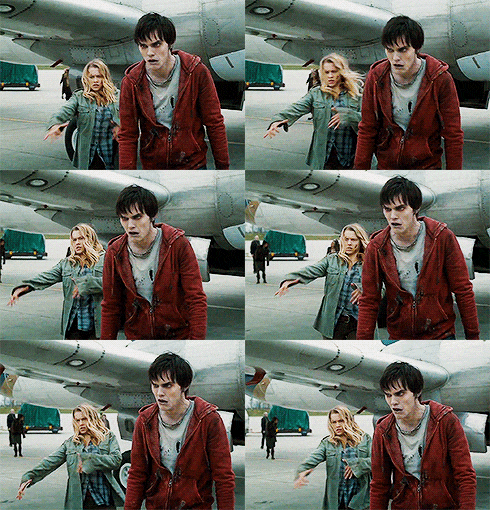
I hate to say it, but the movie was better. The movie is HILARIOUS. Okay. This is sort of a retelling of Romeo and Juliet with zombies. How could that go wrong?
Strike 1: It’s in first person present tense. I wish this trend would just die.
Strike 2: It’s not funny. This was a gold mine for funny things, and it was as if the writer went out of his way to make funny situations not funny.
Strike 3: It rambles. Ninety percent of the book is rambling about Deep Thoughts(TM) such as, Is life worth anything when it’s only about survival? What does it mean to be human? I guess these are big questions when you’re a teen, but for a middle-aged adult, this is Been-There-Done-That territory.
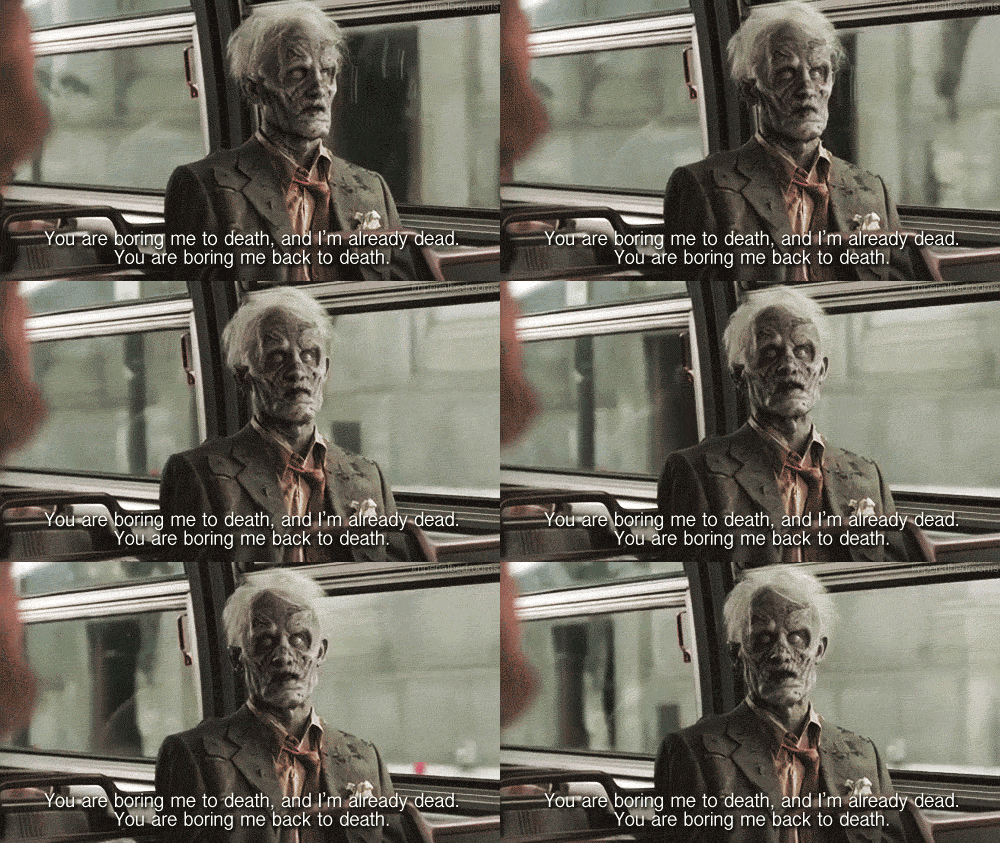
Bonus Strike: There’s a lack of logic. Being around a human girl starts to humanize the boy zombie and other zombies, but there’s no explanation given as to why this works.
* * *

Helena has a husband and two small children. She also has a secret they don’t know about: She was raised off the grid by her teen mother and her father is the man who abducted and raped her mother. When her father escapes from prison (killing two guards in the process), Helena believes she’s only one who can catch him.
The book alternates between the present (first person present tense) and the past (first person past tense), featuring Helena’s childhood in the marshes of Michigan’s Upper Peninsula. There’s actually very little happening in the present. You don’t find out how Helena and her mother escaped the marsh until the end.
I found the middle dragged a lot because it was all about hunting and fishing and nature stuff, and I was hoping for more suspense and action.

With so little time spent in the present, I never got a sense of who Helena was as an adult. She kept saying she wasn’t a kid anymore, but I never saw why or how.
So the ending was pretty exciting, but it was rather slow until then. I found this more of a contemporary novel than a thriller. It’s very character-driven.
There were a lot of sentence fragments. It made me wish I’d been the acquisitions editor for this so I could return it with the note, “Resubmit when you’ve proven you can write in complete sentences.” Look at this paragraph:
I think about the dead prison guards, about their families. About the grief that will consume them long after my father is once again behind bars. I think about this man’s family. How they’re going about their day as if it were normal. How they have no idea that their husband and father and brother is gone. I think about how I’d feel if something happened to Stephen.
That’s three complete sentences and three fragments. I just can’t with this kind of writing.
no strong language or sexual content beyond mentioning rape; some violence, including hunting and abuse/torture
* * *

When my mom was little, she was in a book club that mailed a book every month. When I was 9 or 10, she gave me about five of these books, and this was one of them. I didn’t even know it was part of a series until just recently.
I first read it when I was very young and found it a fun adventure. I just read it for the second time. It’s a quick-moving story that aims to introduce kids to certain scientific concepts.
It’s interesting to read a story about going to the moon that was written before the moon landing. It was written before humans ever saw the earth from a distance and before anyone saw what the far side of the moon looks like.

* * *

This is a fascinating account of life as an undercover FBI agent. Tamer Elnoury is an identity created by the FBI to expose terrorists. The identity has since been burned, so the agent, who is still active, uses it for his pseudonym.
Tamer was born in Egypt and immigrated to the US as a small child, so he is natively fluent in both Arabic and English. He found his calling in law enforcement, where he worked undercover to bring down drug lords. Eventually he was recruited for counter-terrorism.
The book tells of a particular case that started out as a favor to Canada but grew as more evidence was found. Tamer is a very self-confident, almost cocky guy, which is essential to working under cover.
Befriending jihadists was especially tiring for him—he had to watch people twist something personal and sacred to him and pretend to agree with their rationalizations for evil. That takes a special kind of mental endurance, and I’m in awe of that.
Recommended for anyone interested in police work, spies, and life as an American Muslim. Editing was good except for the “alright” spellings.
* * *

Slip and Scout are twins attending Super Hero School. Their father can turn invisible and is a popular superhero. But all Slip can do is turn black like a silhouette. Scout can turn invisible but can’t see when he does. All of their classmates have managed to graduate, so they’re now with a small class of kids with lame powers who are getting too old for school but can’t prove their powers are useful.
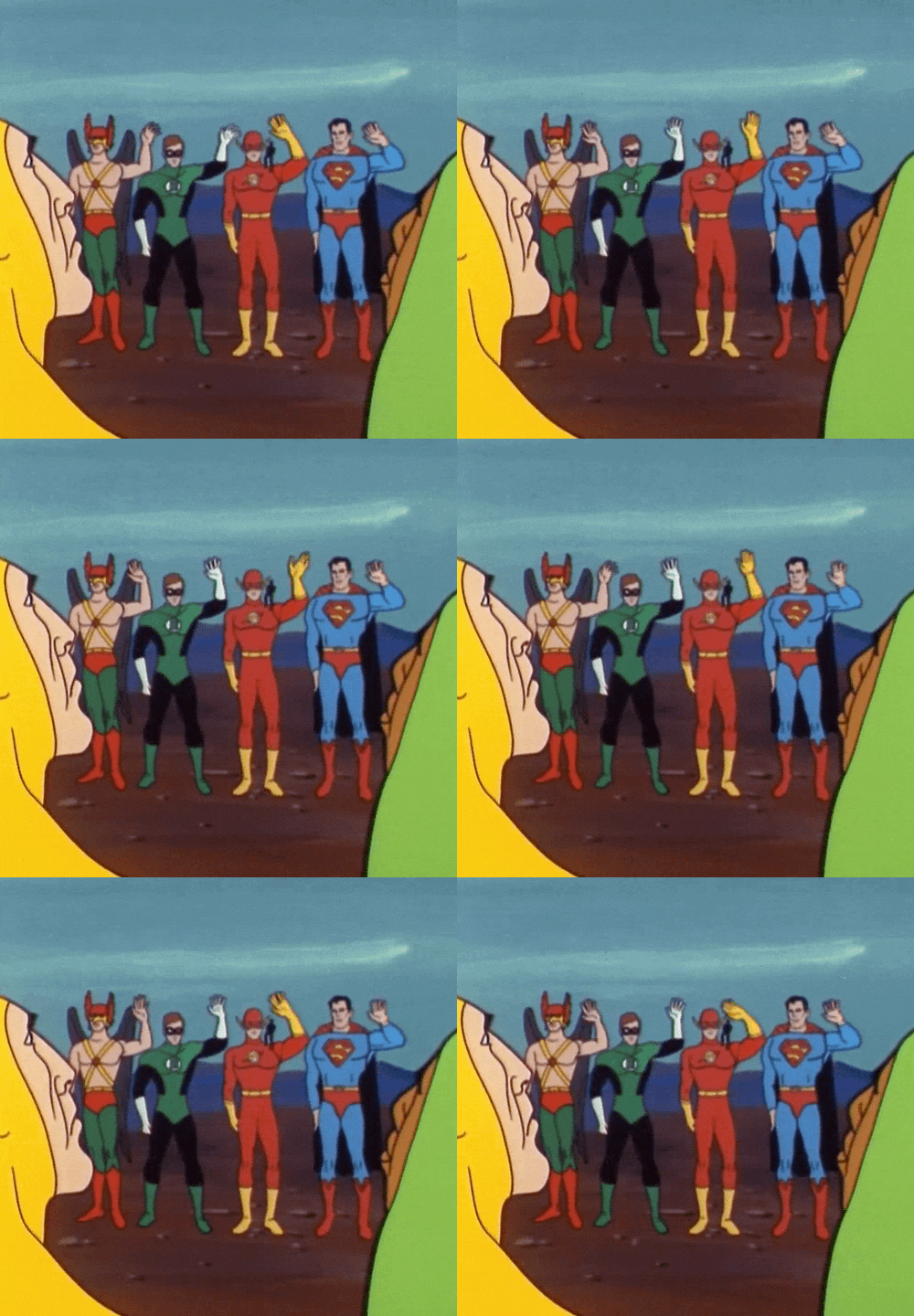
The first half is pretty good, attending school and being misfits and all that stuff. They start calling themselves Supes because they aren’t good enough to be Supers, and this leads to a bunch of soup puns.

Then the second half really picks up, and the final third was just a blast to read. There’s a lot of character development and some surprises. It’s a light, fun read ideal for superhero fans.
No strong language or sexual content; some mild violence.
* * *

Well, if you can look past all the logic issues, it isn’t too bad. When I first marked this as To-Read, I thought it was a dark humor story about the legendary grim reapers. Instead it’s a semi-melodramatic tale that waxes philosophical about immortality and what it means to humanity.
It’s been a couple hundred years since humanity achieved immortality through medicine. There is world peace thanks to a self-aware AI,
To control overpopulation, some people have the job of Scythe, where they go out and kill so many people a year. The only difference between “good” Scythes and “bad” Scythes is that the bad ones enjoy killing. Even the good Scythes will dole out agonizing deaths. The end result is the same.
There is zero description of buildings, cities, cars, or culture. What is this society like? It’s not clear. Most of the plot is predictable. The characters were pretty one-dimensional, but it didn’t bother me too much here. Pacing was just a tad slow at times. It tried to be profound, but I found it melodramatic. The writer seemed to change his mind about what the core theme of the story was. I had a different idea for the final showdown, and I think I like my way better.
These are some of my questions about the logic:
• Why not let people who die of stupidity and suicide stay dead, rather than bring them back to life and then going out and killing someone else who isn’t stupid or doesn’t want to die?
• Why not enforce a maximum age limit or maximum number of children?
• Why give out agonizing deaths? Why doesn’t everyone just get a lethal injection?
• It was a little too convenient how Citra suddenly got off her murder charges, which were completely forgotten, and faced no consequences for running away or anything.
• I have a hard time buying that people can come back from the dead, yet space travel is too hard.
• I have a hard time buying that all religions disappeared because of immortality. There’s just this one cult that’s new, and the attitude toward them was borderline offensive.
Even though there’s a lot to criticize, I still enjoyed it overall. Maybe it’s because of the streak of two-star reads I just had.
Audio narration by Greg Tremblay is pretty good.


No comments:
Post a Comment