


This is a great book for the young YA/older MG crowd, which is largely neglected. It’s a genealogy story with a big mystery in it. I was surprised at how suspenseful the mystery was. I’ve read a lot (all I could find) of Nixon’s YA mysteries, and she really is a master of suspenseful. Her books are always hard to put down. I was just surprised that this genealogy-based story was equally suspenseful and hard to put down.
A very fun, quick read!
* * *

This conclusion to the Wayward Pines trilogy is a straight-up monster movie:

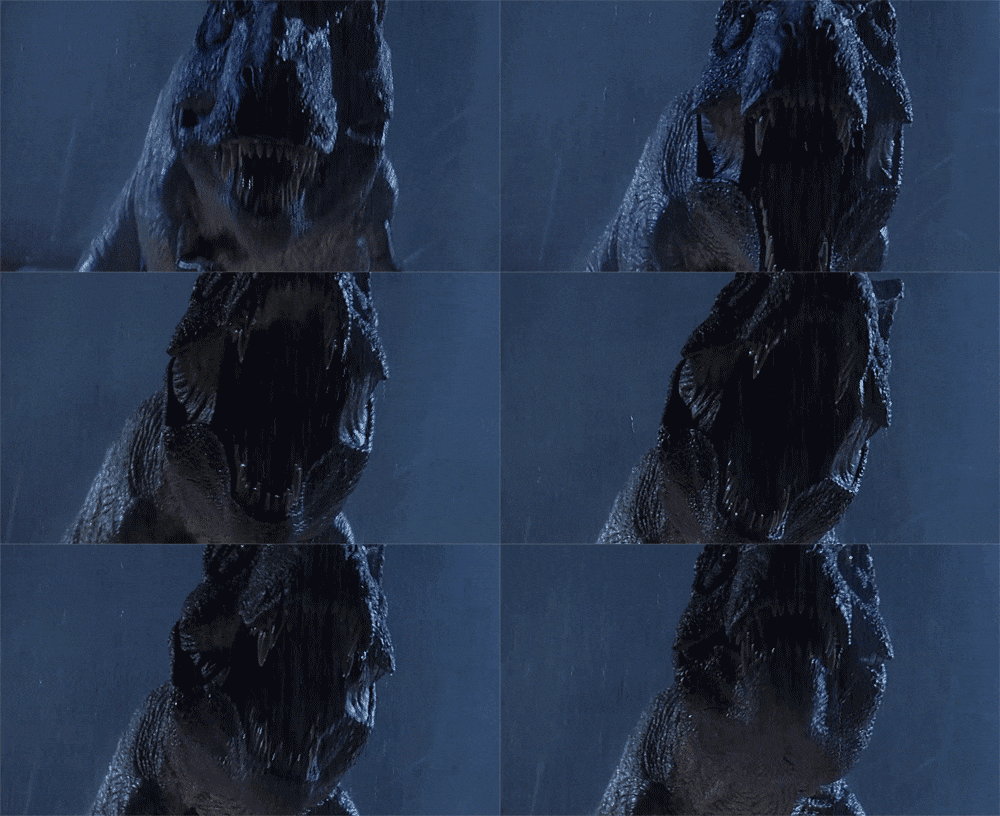
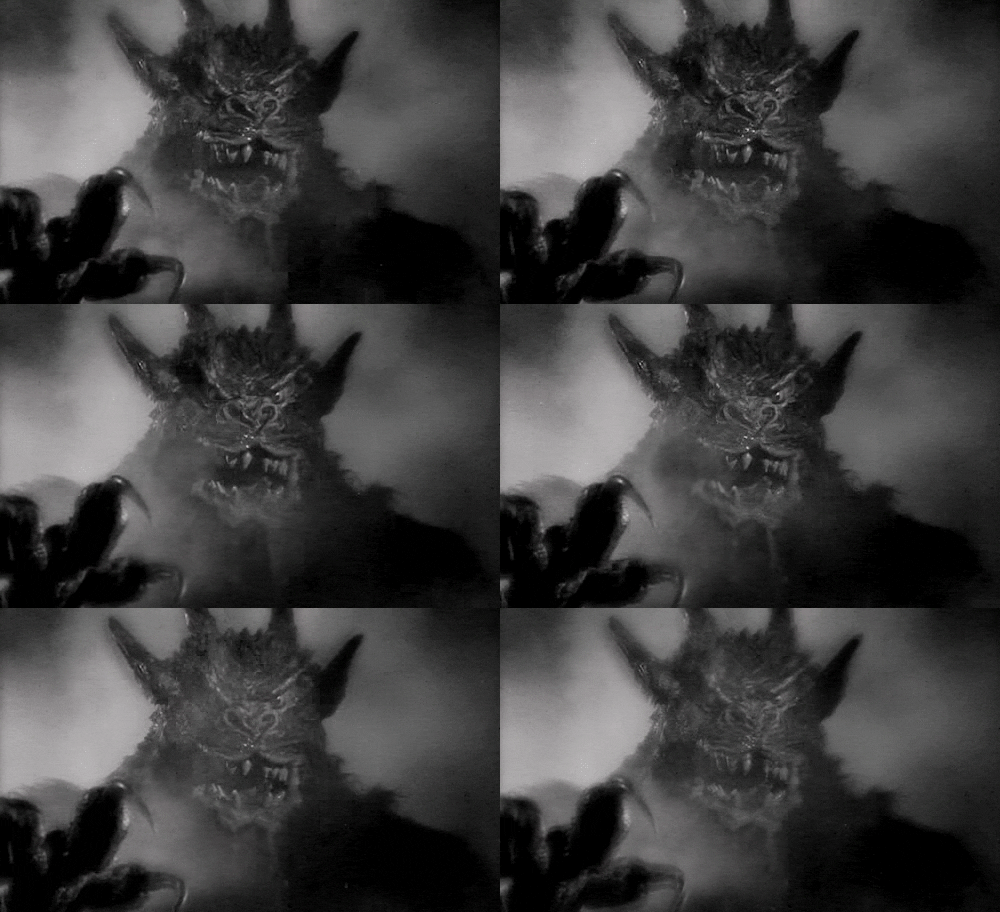

That’s about it. The writing is fine, despite the Dramatic Sentence Fragments and sentences with subjects left out. The ending is kind of weak, as if Crouch couldn’t think of an ending while writing the series and then ran out of time to think of one and had to just end it.
* * *

This is a very informative book by a marijuana addiction doctor. The first part is the science and facts about marijuana, the second part is about the debate about legalization in America, and the third part is overcoming addiction for yourself or loved ones. This third part didn’t apply to me, so I skimmed that part more. I’m not a fan of biology, but I am interested in physiology and pharmacology. I also wanted to get more information about legalization policies. Here are some key points I found interesting:
● Marijuana is addictive, though less addictive than other substances. (I didn’t know it was considered a nonaddictive drug.)
● Far more people are addicted to marijuana than opioids. In fact, the vast majority of prescription opioid users (like myself) are using them responsibly. To say we have an “opioid epidemic” is an exaggeration.
Considering the substantial number of people who use marijuana and become addicted, it is puzzling that we hear more about the potential dangers of opioid use than the risk of addiction to marijuana. This is especially true when we consider that the number of Americans affected by marijuana is so much greater than the number affected by opioids, including heroin. The same holds true for methamphetamine and other illicit drug use.
● Marijuana use in teens causes a permanent drop in IQ. (I have a friend who saw this firsthand with her students. She teaches high-risk, criminal teens.)
● Marijuana today is far more potent than that used in the 60s, 70s, and 80s. Baby boomers and middle-aged adults who used in then may think it’s not a big deal and not realize that it’s different now.
In those decades, the average THC content was about 1-2 percent. The latest average THC content established in the United States is 13 percent. … Also, keep in mind that marijuana with a THC content in the range of 27 percent can be purchased.
● “Medical marijuana” is not the same as cannabinoid drugs. There are already FDA-approved cannabinoid drugs available in every state. Medical marijuana means using a medical excuse to use ordinary THC-rich marijuana, which has not showed promising uses for medical conditions. It’s also usually smoked, which is never healthy for you.
According to a 2011 story in the Huffington Post, by 2011 Denver had more medical marijuana dispensaries than it had Starbucks coffee shops. It seems very unlikely that there is a greater medical need for marijuana in Denver than the recreational consumption of coffee products.
As a fan of personal liberty, I lean in favor of decriminalization and legalization. However, implementing sound policies that prevent abuse and misuse by children is still a tricky process. There’s still a lot to learn, and it seems like a good idea to observe Colorado and Washington for a while and learn from them before doing the same in other states.
Overall, a good, informative book if you are interested in the subject.
* * *

This was written in 1967ish, and I can see why it holds its own through the years. There are some humorous moments and an interesting plot and good characters. The writing is great. I was just kind of bored through much of it. I’m not 12, and I’m not from the 60s.
spoiler
I was never quite sure why Claudia insisted on running away if it wasn’t going to be permanent. And how on earth did she decide hang out in a museum the whole time? I got annoyed when she corrected her brother’s grammar, mostly because she was wrong most of the time. And I didn’t find the mystery of the statue very interesting.
* * *

This is a solid sci fi detective novella. Brandon implies that it’s in the same world as the Reckoners.
The premise is fascinating, and the execution is flawless. The characters are distinctly flawed and relatable, the pacing never slows, and the entire plot is gripping. Given the premise, you kind of expect a certain twist, but Brandon still manages to blindside you with surprises.

* * *

I think any fan of Kings of the Wyld will find this satisfying. It’s a bit more serious, but it still has the snide dialogue and band references and alliteration that we’ve come to love.
I am really, really horrible when it comes to band names and even song titles (let alone individual band members). I can tell you that my favorite band is Depeche Mode, but I couldn’t tell you any of the members’ names. So I know I missed tons of references in this book, but it didn’t detract from the actual plot, and I still got Men Without Helments, Quarterflash, WHAM, and Rich the Lion.
The book just felt kind of long to me. There’s tons of battles and fighting, and nothing felt extraneous, but it was just long.
The characters are great. They are all deeply flawed, which allows for a lot of plot and character development. So if you’re tired of Miss Special who’s so perfect and full of specialness, this book will be extremely refreshing. Almost every character has to deal with or confront his or her father in the book, which was an interesting theme to think about.
Evil thrives on division. It stokes the embers of pride and prejudice until they become an inferno that might one day devour us all.
* * *

This was Ravenspell meets Redwall — definitely Middle Grade, and I felt too old for it. (There’s plenty of MG I have no trouble enjoying.)
The writing is pretty good, and the characters are good. I thought it pretty bold of Collins to have a 2-year-old character. (To be realistic, she should have been crying ALL the time.) The story encourages problem-solving through scientific principles. I think I expected it to be funnier for a kids’ book. It looks like this is the beginning of a long series, but it wraps up pretty well to leave as a stand-alone.
* * *

Time is a drug. Too much of it kills you.
In the Discworld, gods have power according to how many believers they have. Large gods have lots of believers, and small gods have few. If they have none, they die or fade away. Om is the god of Omnia, which has lots of monks and priests and bishops, and they have an Inquisition going and want to impose their beliefs on others at spearpoint. The problem is that Om is down to just one actual believer: Brutha (Brother Brutha).
Only Brutha can hear Om speak. Om is stuck in the form of a tortoise, and everyone (particularly eagles) wants to eat him. (Make a drinking game of it: a shot every time someone says, “There’s good eating on them.”)
Om keeps pronouncing creative curses on everyone, to no effect, and it’s just hilarious. He is a great character. Brutha is the classic British underdog/loser/reluctant hero. He’s pure in heart and just lovable. Brutha and a few others head off an expedition to Ephebe, which is full of philosphers after the ancient Greek fashion, which opens up more things to mock.
The whole plot is full of satire, but it’s all fun and never mean-spirited. There’s even a bit of wisdom beneath it all.
* * *

Overall, it’s an interesting story: A blackmailer starts a blackmail job that doesn’t go quite as planned and ends up running from dangerous dudes while also trying to solve the mystery of what just went wrong.
My big issue is that the main character, Galen, is such an insufferable prat. He is close-minded, intolerant, and judgmental—everything he claims he hates about everyone else. If I didn’t personally know Johnny, I’d have been very offended by Galen. I kept hoping there would be a twist at the end where he ends up in prison forever or something, but he just keeps on being the hero of the story.
Content Warning: moderate strong language and sexual content.
It also needs some serious copy editing!


No comments:
Post a Comment